

Flock & Meadow › Why Fiber Matters › What Is Superwash Wool?
What is Superwash Wool?
Wool is remarkable. It can keep us warm, absorb moisture, stretch, recover its shape, and transform into felt. But one of its most useful characteristics can also make it difficult to wash.
Why does wool felt, and how does superwash treatment change that behavior?
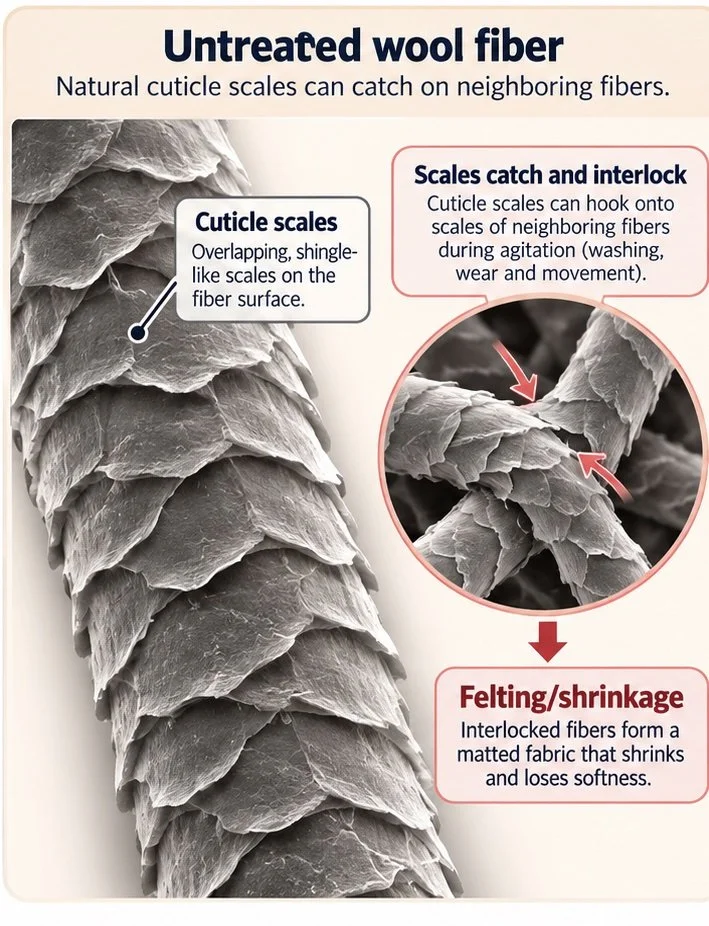
Illustration: Untreated wool has overlapping cuticle scales that can catch on neighboring fibers.
Why Does Wool Felt?
A wool fiber is covered with microscopic overlapping scales, rather like shingles on a roof.
When wool becomes wet and experiences mechanical movement, these scales can catch against neighboring fibers. The fibers gradually migrate and become entangled. As the structure becomes denser, the material shrinks.
This process is called felting. Once wool has become thoroughly felted, its original structure is difficult or impossible to restore.
Can Superwash Wool Still Felt?
Yes. Superwash means shrink-resistant, not absolutely incapable of felting.
Treatment effectiveness varies, and sufficiently harsh conditions may still damage or distort the yarn.
Why Does This Matter to Dyeing?
Superwash treatment changes the surface through which water and dye molecules must travel.
Although the treatment is intended to improve washability, it can also change the way wool absorbs dye.
This leads to an interesting question:
Does changing the surface of wool change the color we see?
That is something we can investigate.
Why Is Wool Superwashed?
Superwash treatment was developed to reduce wool’s tendency to felt and shrink during laundering.
By modifying the surface of the wool fibers, manufacturers can produce yarns and fabrics that withstand appropriate machine-washing conditions while retaining many of wool’s desirable properties.
Superwash wool remains wool. Its fundamental protein structure is not replaced by another fiber.
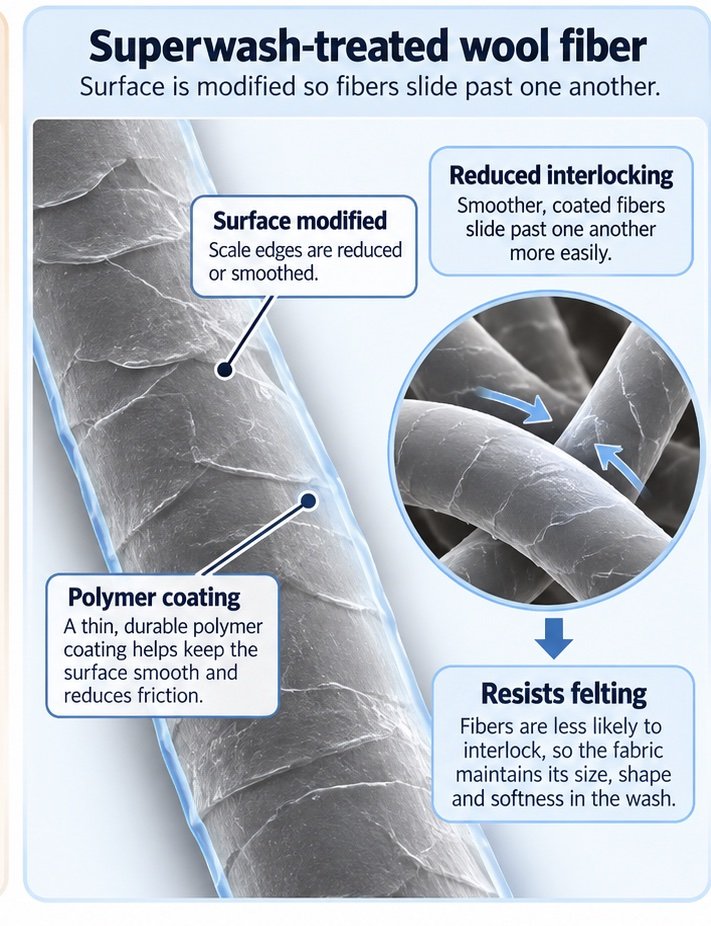
Illustration: A conventional Chlorine-Hercosett finish modifies the cuticle and adds a thin coating. Diagrams are schematic, not actual microscope photographs.
How Is Superwash Wool Made?
One of the most established industrial methods is called the Chlorine-Hercosett process. It has two principal stages.
Stage 1: Surface modification
The wool is treated with controlled chlorine chemistry. This changes the outer cuticle, modifies the scale edges, and makes the surface more receptive to subsequent treatment.
Stage 2: Polymer treatment
A specialized resin called Hercosett is applied. It forms a very thin layer associated with the fiber surface, helping prevent neighboring wool scales from interlocking.
Sources and Further Reading
The Woolmark Company. “Machine Washable Wool.” https://www.woolmark.com/industry/product-development/processing-innovations/machine-washable-wool/
“A Review of the Sustainable Methods in Imparting Shrink Resistance to Wool Fabrics.” https://pmc.ncbi.nlm.nih.gov/articles/PMC6369147/
Tester, D. H., and Makinson, K. R. (1983). “A TEM Study of the Causes of Failure in the Chlorine-Hercosett Shrink-Resist Process.” Textile Research Journal, 53(7). https://doi.org/10.1177/004051758305300704
Visuals: original explanatory illustrations created for Foosheeko; not source microscopy images.