
Flock & Meadow › Why Fiber Matters › Dyeing Superwash Wool›Is Superwash Only for Wool?
Is Superwash Only for Wool?
not every washable fiber is superwash, and not every shrink-resistant treatment works by the same mechanism.
〰️
not every washable fiber is superwash, and not every shrink-resistant treatment works by the same mechanism. 〰️
Foosheeko | Why Fiber Matters
We often encounter the word superwash on labels for sheep's wool yarn. The term generally describes wool that has been treated to resist felting and shrinkage during machine washing.
But sheep's wool is not the only natural fiber that can felt or shrink.
Does that mean other fibers can receive superwash treatment?
The answer is more interesting than a simple yes or no. It depends on the fiber's microscopic structure, its chemical composition, and the reason it shrinks in the first place.
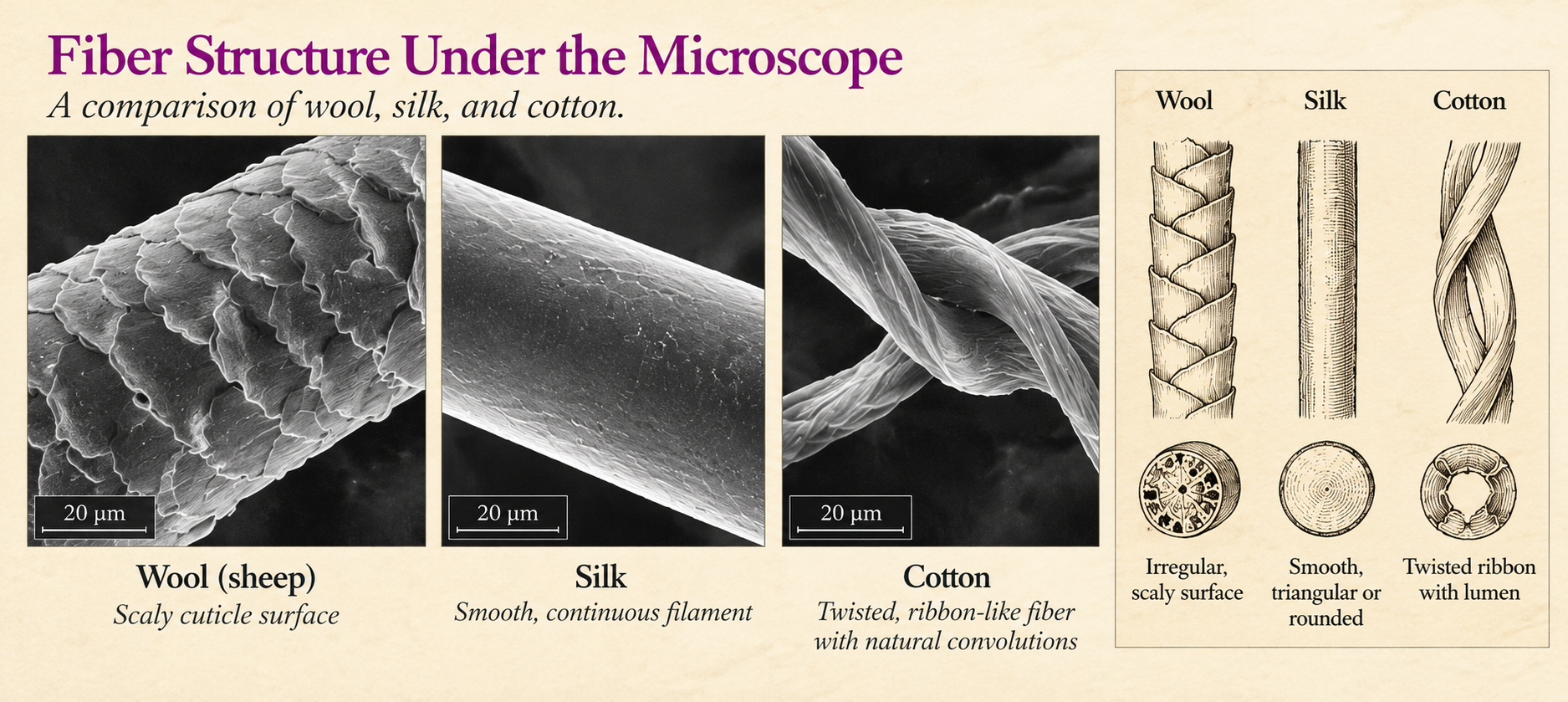
What Does μm Mean?
The symbol μ is the Greek letter mu (pronounced mew). Combined with m for meter, it forms μm, meaning micrometer, also called a micron.
One micrometer is one-millionth of a meter (0.001 millimeter).
Microns are particularly important in the fiber world because they are used to measure fiber diameter. Wool with a lower micron measurement is generally finer and softer against the skin, while wool with a higher micron measurement is generally coarser. Fiber structure and other characteristics also influence how wool feels.
In genuine microscopic images, a calibrated scale bar labeled 20 μm represents a distance of 20 micrometers, helping us understand structures too small to see with the naked eye.
About this illustration: These are artistic representations of microscopic fiber structures, not actual electron micrographs. The 20 μm scale bars are illustrative and do not represent verified measurements.
Wool Is Not the Only Fiber with Scales
Sheep's wool belongs to a larger family of animal hair fibers composed primarily of keratin, a structural protein also found in human hair and fingernails.
Cashmere, mohair, alpaca, and many other animal fibers possess overlapping surface scales called cuticles. These scales influence how fibers interact with one another, especially when exposed to moisture and mechanical movement.
Under suitable conditions, the fibers can move against one another and become increasingly entangled. This process produces felting, which may also cause a knitted or woven textile to become denser and smaller.
But animal fibers are not identical.
Their scales vary in shape, height, frequency, and arrangement. Their diameters, lengths, flexibility, and natural crimp also differ.
Consequently, fibers with seemingly similar surfaces may behave quite differently during felting.
These differences are important when considering shrink-resistant treatments.
So Where Does Superwash End?
The word superwash is most firmly established in the wool industry.
It generally describes wool that has been processed to resist felting shrinkage sufficiently to permit specified machine-washing conditions.
Traditional treatments may modify the fiber's cuticle scales, apply a polymer to its surface, or combine several approaches.
Other animal hair fibers may undergo shrink-resistant processing, but the presence of such a treatment does not necessarily mean that the same industrial process was used.
For silk, plant fibers, and synthetics, washability and shrink resistance often involve entirely different structural problems.
It is helpful to distinguish three related ideas:
Felting resistance — The ability of a fiber or textile to resist the progressive entanglement and compaction associated with felting.
Shrink resistance — The ability of a textile to resist unwanted changes in its dimensions, regardless of the mechanism responsible.
Machine washability — The ability of a finished textile to tolerate specified machine-laundering conditions without unacceptable changes in dimensions, appearance, or performance.
These qualities overlap, but they are not interchangeable.
A textile can resist felting and still shrink for other reasons.
A textile can resist shrinkage and still suffer other kinds of washing damage.
And a product labeled machine washable has not necessarily undergone any treatment resembling the superwash processing used for wool.
A Foosheeko Question
If wool, alpaca, and silk are all protein fibers, will the same acid-dye formula produce the same color on each?
The answer requires us to look beyond the dye itself.
Different fibers possess different chemical structures, surface characteristics, and abilities to interact with dyes. Even when the same general class of dye can be used, identical dyeing conditions do not guarantee identical color results.
It is another question that invites us to investigate, experiment, and observe.
And that is where the next discovery begins.
Why Does This Matter to the Fiber Artist?
For someone choosing materials for knitting, weaving, spinning, dyeing, or felting, these distinctions have practical consequences.
A fiber selected for traditional wet felting must be capable of forming a sufficiently stable, interconnected structure.
A fiber intended for machine-washable knitwear may need to resist that very process.
A treatment that makes wool particularly suitable for a washable sweater may make it poorly suited to traditional wet felting.
Likewise, two natural protein fibers may respond differently to the same processing conditions because their internal structures and surface characteristics differ.
There is no universal treatment that makes all fibers behave alike.
The behavior of a finished textile begins with the nature of its fibers, continues through the processes applied to them, and emerges in the fabric we eventually use.
Understanding those relationships gives us more than a care label. It gives us a way to investigate the material itself.
Beyond the Sheep: Other Animal Fibers
Cashmere — The Goat's Fine Undercoat
Cashmere comes from the exceptionally fine undercoat of certain goats.
Like sheep's wool, cashmere has overlapping cuticle scales and can felt when exposed to moisture and mechanical agitation.
Shrink-resistant finishing treatments have been developed for cashmere textiles, including investigations of chemical, enzymatic, and plasma-based methods.
However, cashmere's delicate fibers and characteristic softness make the choice of treatment particularly important. A process that successfully reduces felting must also be evaluated for its effects on the fiber's strength, appearance, and feel.
Mohair — The Angora Goat's Lustrous Fleece
Mohair comes from Angora goats, but its structure differs considerably from that of cashmere.
Mohair fibers generally have comparatively smooth, flattened cuticle scales. This surface structure contributes to their characteristic luster.
Although mohair may be less prone to felting than some types of sheep's wool under comparable conditions, it is not immune to felting.
Shrink-resistant finishing methods can be applied to mohair textiles, but the appropriate method depends on the characteristics of the fiber and the intended product.
Alpaca — A Different Kind of Scale
Alpaca offers a particularly interesting comparison.
Alpaca fibers generally have less prominent cuticle scales than sheep's wool, yet they can felt remarkably well.
In fact, researchers Xin Liu and Xungai Wang reported in a 2007 study that the alpaca fibers they tested exhibited a greater tendency to felt than the wool fibers used for comparison.
How can fibers with relatively smooth surfaces felt so effectively?
Because felting does not depend on scale height alone.
Fiber length, diameter, flexibility, directional friction, and the ability of fibers to move and become entangled all influence the process.
The study also demonstrated that differences in fiber length and previous processing affected felting behavior.
Research into modifying alpaca's surface structure has explored ways to influence properties such as friction and shrink resistance.
However, a treatment developed for sheep's wool should not automatically be assumed to produce identical results on alpaca.
A smoother-looking fiber is not necessarily a fiber that cannot felt.
What About Silk?
Silk is also an animal-derived protein fiber, but it introduces a fundamental difference.
Wool and animal hair are made primarily of keratin. Silkworm silk consists principally of another structural protein called fibroin.
The familiar continuous filament produced by a silkworm does not possess the overlapping cuticle scales characteristic of wool.
Consequently, silk does not undergo the same scale-driven felting process that causes untreated wool to become densely matted.
Silk fabrics may still shrink, distort, lose their shape, or experience changes in appearance during washing.
Manufacturers can use finishing treatments to improve their dimensional stability and washability, but traditional wool superwash treatment is not the solution to these problems.
Silk illustrates an important principle:
Two fibers can both be proteins without sharing the same structure or behavior.
What About Cotton and Linen?
Cotton and linen belong to an entirely different family of natural fibers.
Unlike animal hair and silk, these plant fibers consist primarily of cellulose, rather than protein.
They have no wool-like overlapping cuticle scales.
Yet cotton shirts shrink, linen fabrics change dimensions, and both can require careful laundering.
Why?
During spinning, weaving, knitting, and finishing, textile fibers and yarns are subjected to tension and mechanical forces.
Some of these stresses remain within the finished textile.
When the fabric is washed, the fibers and yarns can rearrange and relax, changing the fabric's dimensions.
Manufacturers have developed specialized methods for controlling these changes.
For example, Sanforizing is a mechanical process that deliberately compresses fabric under controlled conditions, reducing the amount of shrinkage likely to occur during later laundering.
Other finishing processes may involve chemical treatments that improve dimensional stability.
These processes address problems different from the scale-driven felting of wool.
The result may be a washable, shrink-resistant textile, but it is not ordinarily described as superwash cotton or superwash linen.
And the Synthetic Fibers?
Manufactured synthetic fibers introduce still more possibilities.
Polyester, nylon, and acrylic are made from synthetic polymers rather than keratin or cellulose.
Their surfaces do not naturally possess the overlapping cuticle scales characteristic of animal hair.
They may resist ordinary laundering shrinkage relatively well, but their dimensional stability depends on their chemistry, manufacturing, and fabric construction.
Some synthetic textiles undergo heat-setting, a process in which controlled heating helps stabilize the arrangement of their polymer structures and the dimensions of the finished fabric.
Others may distort or become damaged if exposed to unsuitable temperatures.
Once again, washability can be improved without using a treatment that resembles wool superwash processing.
Sources and Further Reading
Woolmark. Machine Washable Wool. Overview of superwash processing, fiber-scale modification, and shrink-resistant treatments.
https://www.woolmark.com/industry/product-development/processing-innovations/machine-washable-wool/Liu, X., & Wang, X. (2007). A Comparative Study on the Felting Propensity of Animal Fibers. Textile Research Journal, 77(12), 957–963.
https://doi.org/10.1177/0040517507083517Hua, W., Islam, F. F., & Memon, H. (2020). Influence of Ultraviolet Irradiation and Protease on Scale Structure of Alpaca Wool Fibers. AUTEX Research Journal, 20(4), 476–483.
https://doi.org/10.2478/aut-2019-0039Moges, G., Pawlos, M., Ahmed, S., & Debebe, E. (2026). Green Solutions for Enhancing Flame Retardant, Shrink-Proof and UV-Protection Finishing of Protein Fibers: A Comprehensive Review. Journal of Engineered Fibers and Fabrics.
https://doi.org/10.1177/15589250261416492
Research Note: Commercial fiber labels do not always identify the specific finishing process applied. When a treatment matters for dyeing, felting, or other fiber work, the manufacturer's technical information is more useful than assuming that terms such as washable and superwash mean the same thing.