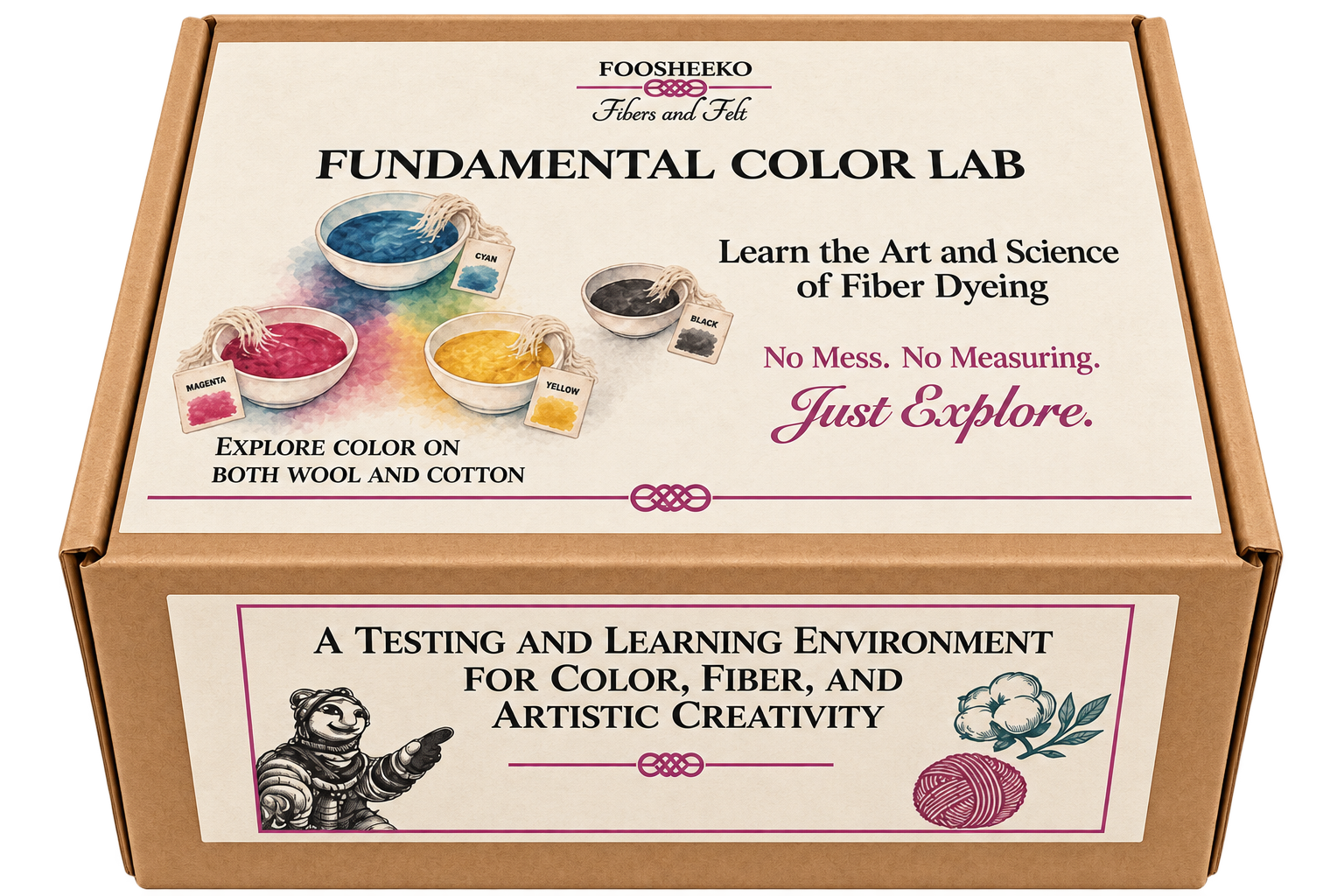
This is where Foosheeko began - at a lab table, with curiosity, color,
and a desire to make fiber dyeing accessible to everyone.
Here is the story of the problem I was trying to solve
and the solution I built.
From Dr. Kat’s Lab Table
Before Foosheeko came to be, there was a problem I was trying to solve for myself. I wanted to dye wool yarn and luscious fibers in any unique color combination I could imagine.
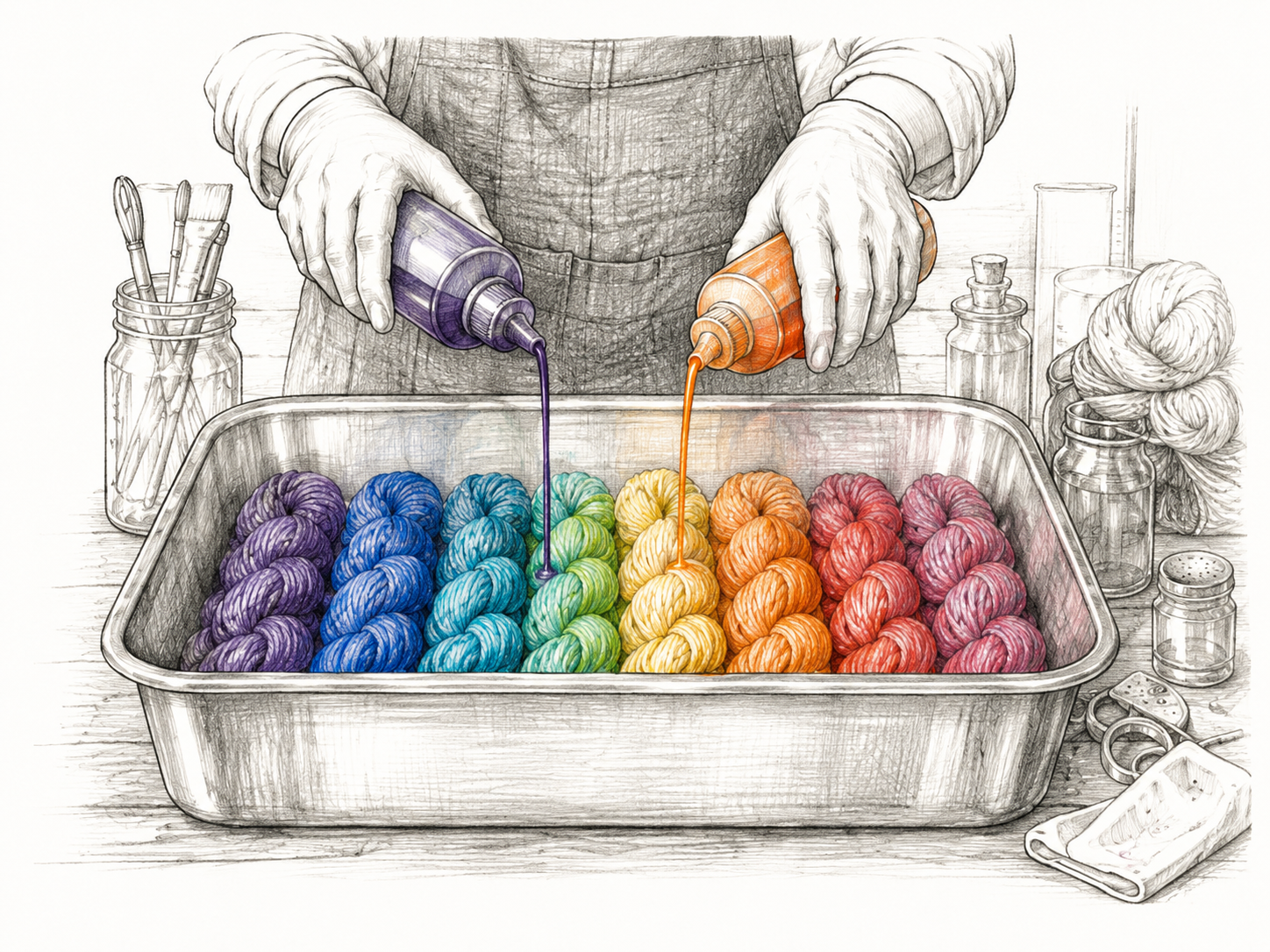
I had seen those intriguing videos showing an indie dyer with a lovely stainless-steel pan full of wool skeins, all lined up and ready to be dyed.
Then the hands in the picture take dye colors and pour them over five skeins at once, lining up the colors until suddenly there is a rainbow inside that rectangular pan. After a little while, those same hands remove the skeins, rinse them, wash them, dry them—and the result is stunning, artistic yarn in colors you can’t wait to use.
It is one of the most satisfying and attractive processes I have ever seen. I could hardly wait to try it myself and create my own collection of beautiful yarn.
But there were problems.
As a beginner, there is a lot going on that you don’t realize while you’re watching the video.
You don’t realize that many of the dye stock solutions and color combinations being made are intended for five full-sized skeins of yarn at a time.
You don’t realize that the pans, spoons, measuring tools, and other equipment that look so familiar must actually be dedicated to dyeing and kept out of food preparation.
You don’t realize that when you make a mistake—and as a beginner, you are supposed to make mistakes—you may end up with five full-sized hanks of yarn in a color you will never use because it came out ugly, muddy, or simply nothing like what you had planned.
You don’t realize that your kitchen may now be a mess.
Or that tiny particles of dry dye can end up in places you cannot even see—until they get wet and suddenly announce exactly where they landed.
And what if you don’t have a dedicated dye studio space?
Maybe you are working in a shared kitchen that has to become a kitchen again before dinner. Maybe you live in an apartment without room to store dye pots, scales, masks, bottles of dye, measuring equipment, and all the other tools that seem to accumulate once you begin.
You may love the idea of dyeing your own fiber and experimenting with color, but don’t have the space—or the desire—to turn part of your home into a dye studio.
And perhaps most frustrating of all, you might even create the most gorgeous color combination you have ever seen…
…and then discover that you have no idea how to make it again.
Those were the problems I wanted to solve.
I wanted a way to explore fiber and color on a small scale—with real dyes and real experiments—without needing a dedicated studio, without measuring dry dye powder, and without producing five skeins every time I wanted to ask, “What would happen if…?”
Then I began thinking about the colors themselves.
I had imagined needing shelves full of different dye colors if I wanted the freedom to create whatever color came into my head. But our computer printers manage to produce an astonishing range of colors from just a few. They do it by combining cyan, magenta, yellow, and black.
That made me wonder: why couldn’t I approach fiber dyeing the same way?
Instead of collecting jar after jar of individual colors, I could begin with a small set of primaries and learn how to combine them.
One of the first things I discovered was that dry dye did not necessarily have to be measured every time I wanted to use it. Dye could be prepared in advance in a small, dissolvable pouch and added directly to the dye bath.
That was a revelation.
But other systems I had seen were still designed around dyeing a full 100-gram skein of yarn. I was trying to solve a different problem.
I did not need another way to dye an entire skein. I needed a way to experiment.
So I began scaling everything down.
How much dye did I really need for one small fiber sample? How much water? How much helper? Could I make one experiment at a time instead of committing an entire skein to every idea? Could I make a mistake, learn something from it, record what happened—and simply try again?
That became the beginning of the Foosheeko dye pouch system.
Once I had reduced the scale of the experiment, I started thinking about the way a computer printer works. What if I began with only four dye colors and learned what they could do together? Instead of choosing a finished color from a jar, I could learn how that color was built. That changed the whole direction of the project.
Now the question was no longer simply, “What color do I want?” It became, “How do I make that color?”
And slowly I realized something else.
I was not simply learning how to dye yarn. I was learning Color Theory. The fiber was simply my medium.
That realization mattered, because it changed what Foosheeko needed to become.
It could not simply be a box of dye and fiber with instructions for producing a pretty result. If the real purpose was learning color, then the Lab needed to encourage observation, comparison & experimentation.
That was when the idea of the ColorTest Sample began to make sense to me. I did not need to sacrifice an entire skein every time I wanted to test an idea. I needed enough fiber to see what the color was doing, enough material to handle and examine, and enough room to make another experiment when the first one raised a new question.
Small samples made mistakes inexpensive. They made comparison possible. And they made curiosity practical.
By then, I also knew I needed someone who could help me put proper language around what I was discovering. That is where Professor Q came in.
I could experiment with dyes and fiber all day long, but Quincy is the artist and art teacher. He could look at what I was doing and recognize the larger principles behind it—the relationships of color, value, contrast, harmony, proportion, and all the other things artists have been studying long before I ever put a dye pouch into a jar.
With his help, I began to see the Lab more clearly for what it was becoming: not simply a way to make colored fiber, but a way to learn color by making it visible in your own hands.
And that, finally, became the idea at the heart of Foosheeko.
Learn. Experiment. Discover. Record. Repeat.